








Ask an AI assistant a factual question and the answer may well draw on Wikipedia, yet you don’t always see it. This is the case with many sources on the internet. Publishers, libraries and broadcasters face similar questions. As the EU debates how AI, transparency, author’s rights and sustainability fit together, a basic question deserves its share of attention: When AI systems, search engines and apps reuse content, can people see where it came from? Is it clear which part of the answer is a citation and which is edited or added? Can we guarantee that the source is not misrepresented?
This post explains the Wikimedia Attribution Framework, a practical, voluntary answer from the Wikimedia Foundation, and what Wikimedia would like AI companies to do with it.
Why attribution & presentation matter
This includes the financial question, but it by far not limited to it:
- Accuracy and trust. A summary can lose a caveat or misquote a figure. A visible source and a working link let readers check, which is the kind of transparency we seem to want from AI.
- Traffic and brand. People who can see and easily open the place where information comes from can go and read more. A recognisable source also builds trust.
- Human editors. Wikipedia is written and kept up to date by volunteers, most of whom started as readers. Without visibility, the path from reader to contributor is lost. The communities of people people who keep a public-interest resource alive might disappear.
- Fundraising: The Wikimedia Movement’s main source of income are donation banners on the projects. If people don’t go to Wikipedia they wont’ see them. Publishers have a similar issue, but with advertising.
What the framework is
Version 1, published in beta in May 2026, is a set of voluntary guidelines for anyone reusing Wikimedia content: search engines, AI assistants, apps, social media and media outlets. It sits alongside existing legal duties, since the open licences already require credit, and it makes meeting them simple and consistent. It has three levels:
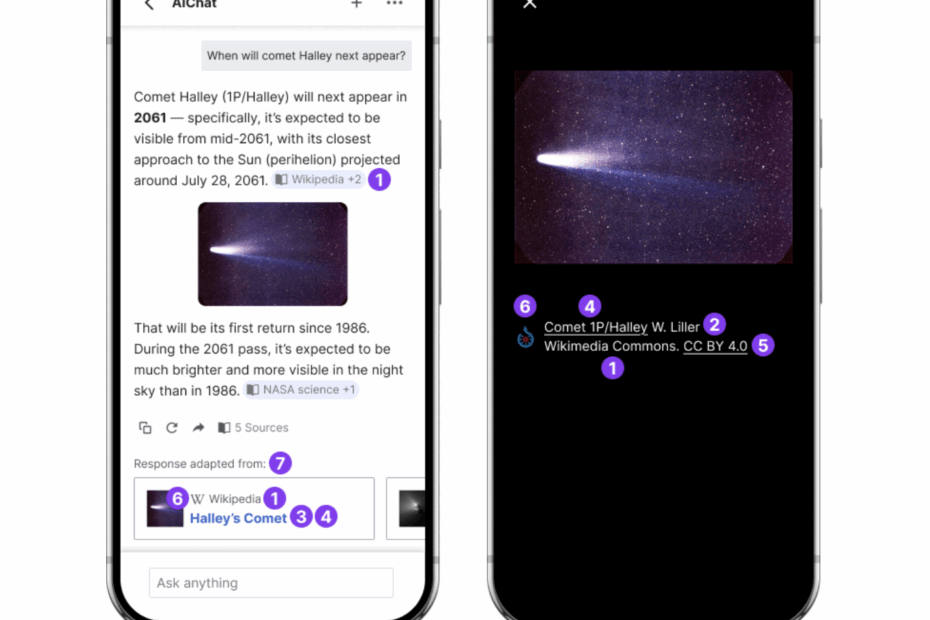
- Essential attribution: the source, title and a link back, plus a clear indication when content has been summarised or changed rather than quoted.
- Trust and relevance: how many people contributed, how many references the article has and when it was last updated.
- Ecosystem growth: invitations to read further, edit or donate, where possible.
What we would like from AI companies
For AI assistants, the recommended set includes the source, a link, the reference count, the contributor count and the last update. A beta Attribution API delivers these signals in one request, and high-volume commercial reusers can expect the same information through Wikimedia Enterprise.
The approach starts from evidence. A November 2025 survey experiment with 1,186 participants found that attribution signals measurably shaped trust in chatbot answers, while the effect was harder to detect in search results. This is early research, but it suggests attribution matters most where it is currently weakest: in chatbot settings. So the baseline request for these is:
- Name the source and link to the specific page used, next to the answer rather than buried in a footnote.
- Say when text has been summarised or changed, so a paraphrase is not mistaken for a quotation.
- Show why the source is trustworthy and invite people in: contributors, references, freshness, and a way to read on or take part.
None of this is technically hard. Perhaps it can also offer EU policymakers a concrete reference for what is reasonable and practical.
The framework is in beta and the Foundation is asking for feedback. Read the framework, the announcement on Diff, the Attribution API documentation and the research.